
Reusable Packaging Lowers Medical Device Packaging Costs by 75% and Improves Shipping Efficiency
2 February 2026
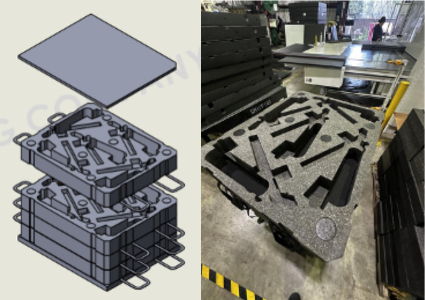
Re-usable packaging switch cuts 75% from medical manufacturer’s per unit packaging cost while slashing shipment weight by 29% and saving 40 minutes of handling time per shipment
Which packaging approach is better?
A medical device manufacturer was evaluating two packaging approaches for shipping robotic manipulator assembly components — precision mechanical subassemblies used to position and articulate surgical instruments in robotic-assisted applications.
While both a single-use and a reusable packaging configuration met functional shipping requirements, the customer needed a clear, data-driven comparison to understand environmental impact, operational efficiency, and long-term cost performance.
The challenge was to align shipment quantities, re-use assumptions, and material inputs across both systems to enable a fair, normalized comparison suitable for internal decision-making.
Absence of a usable, scientific comparison creates risk
Without a standardized evaluation, the customer had limited visibility into how packaging choices affected recurring material usage, handling labor, waste generation and cumulative packaging cost. Decisions based solely on shipment configuration risked overlooking the long-term operational and financial impacts of repeated single-use packaging purchases.
Clear, measurable outcomes were required to support both sustainability goals and operational planning.
Developing an accurate side-by-side comparison
Larson Packaging Company partnered with the customer to develop and evaluate a reusable bulk packaging system alongside the single-use configuration. The reusable solution employed durable trays housed within a returnable bulk container, enabling multiple robotic manipulator assemblies to be shipped per container and subsequently reused across multiple shipment cycles.
To evaluate the benefits, this reusable packaging system was modeled to ship 20 units per container and reused across 10 shipment cycles, while the single-use configuration was modeled as individual unit packs consolidated into palletized shipments.
To ensure a consistent comparison, both systems used virgin polyethylene foam materials.
Environmental and operational performance was evaluated using lifecycle assessment methods, material consumption metrics, and handling-time analysis.
Analysis reveals the hard benefits of re-usable protective packaging
The analysis demonstrated both environmental and immediate operational benefits of the reusable packaging system.
From an environmental perspective, the reusable solution achieved a significantly lower Eco Score on a per-unit basis when compared to the single-use packaging option, driven primarily by material reuse across multiple shipment cycles.
From an operational standpoint, when normalized to 200 units shipped, the reusable system reduced the number of single-use packaging builds required—from eight palletized single-use shipments (including pallets, corrugated sets, and foam) to one returnable container system reused across multiple shipments. This eliminated repetitive corrugated assembly and disposal activities and avoided an estimated 40–60 minutes of packaging handling and waste-management time over the modeled shipment period.
Additionally, the reusable configuration reduced gross shipping weight per load by approximately 29%, improving handling efficiency and transportation ergonomics. When evaluated over ten shipment cycles, the reusable packaging solution reduced per-unit packaging cost by approximately 75% compared to the single-use configuration.
As a result, the customer was able to transition to a more sustainable and operationally efficient packaging strategy that reduced recurring material consumption, simplified warehouse workflows, and delivered meaningful cost improvements over time—while maintaining required product protection and scalability for future volume growth.