
New lightweight engineered foam bunk system delivers a 44% cost reduction while improving scalability and manufacturability
9 June 2026
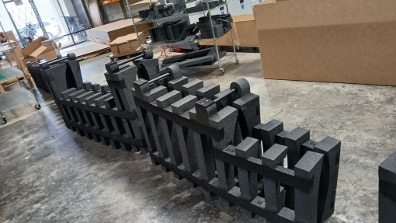
Our customer—an aerospace manufacturer— required a specialized solution to safely transport and process a large-format aerospace wing through multiple stages of their facility, including high-temperature annealing.
While the customer had already developed a metal transport cart, they needed a custom-engineered wing bunk system to securely support the wing while meeting strict handling, thermal, and manufacturability requirements.
The project introduced several critical constraints namely:
- Complex Geometry: The wing’s precise contours required accurate support to prevent deformation or stress damage.
- Modular Design: A 10-section foam system was specified consisting of 5 fixed base sections mounted to the cart and 5 removable top sections for access during handling.
- Manual Handling: Each removable section (approx. 72″ x 30″ x 8″) needed to be manageable by a single operator.
- Thermal Performance: Materials had to withstand elevated temperatures up to ~190°F during the annealing process without degradation.
- Weight Optimization: Even with lightweight foam, further weight reduction was necessary to improve ergonomics and usability.
Solution
We developed a custom foam bunk system engineered directly from the wing’s contour data to provide precise, repeatable support through transport and high-temperature annealing, while also improving ergonomics and manufacturability.
To meet the performance requirements, we selected 1.9 lb density expanded polypropylene (EPP Arplank) for its lightweight structure, durability, and thermal resistance, then precision-cut all components using 5-axis waterjet technology to achieve accurate contour matching and production repeatability.
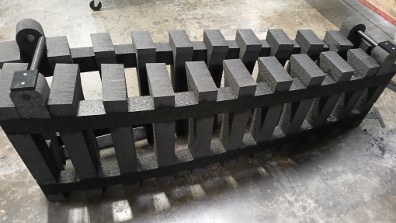
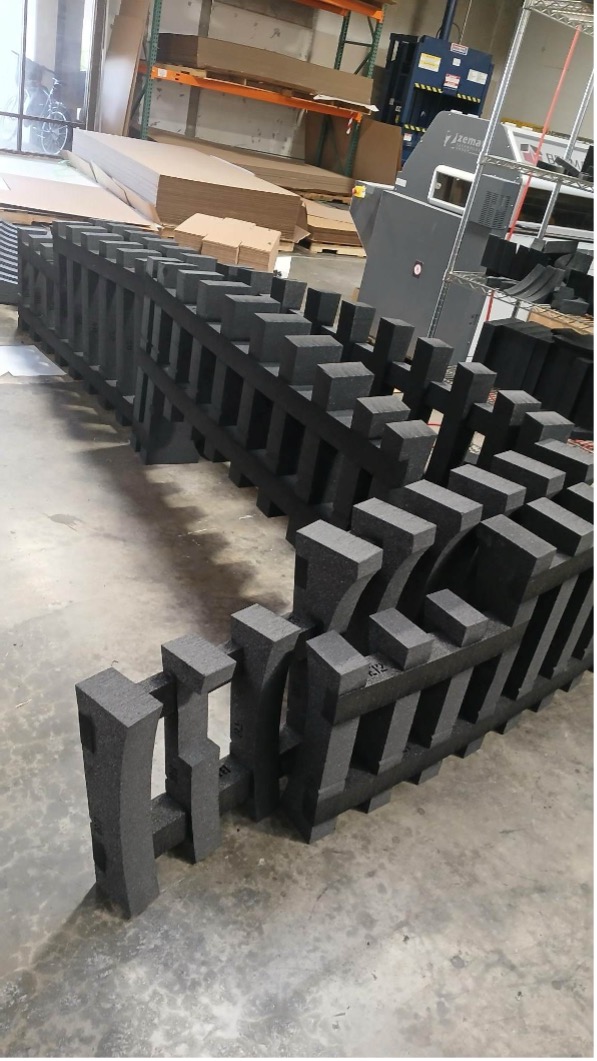
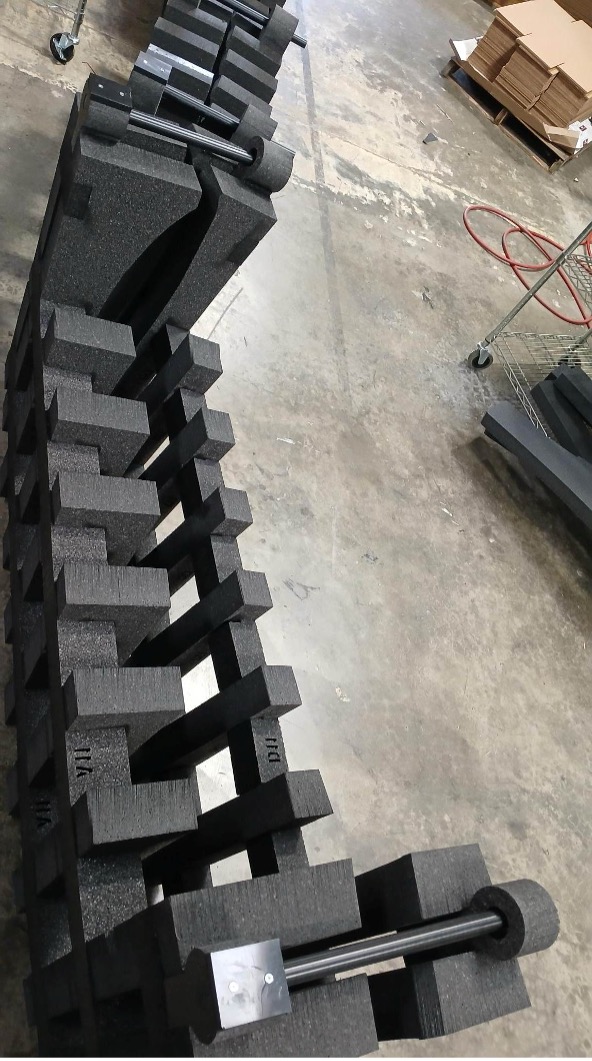
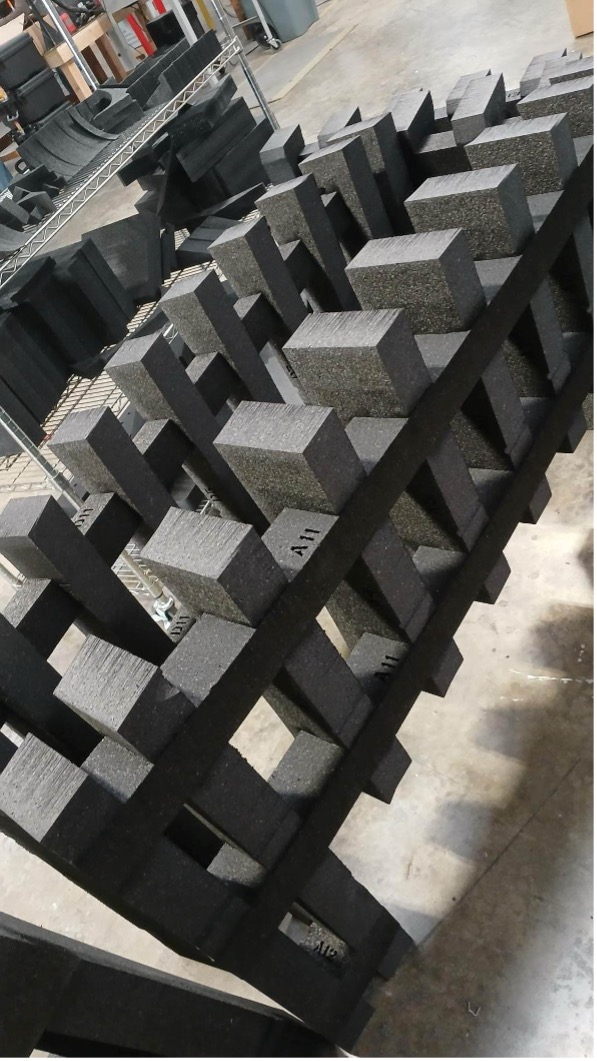
A key innovation was a weight-reduced “skeleton” architecture. Instead of a solid foam mass, the bunk was sliced into 3-inch sections and connected by a central foam spine, which removed unnecessary material while maintaining structural integrity. This open structure also increased airflow around the wing during annealing, supporting more uniform heat distribution and reducing the risk of localized thermal effects.
The bunk system was delivered as a 10-section modular set: five lower base sections fixed to the customer’s metal cart and five upper sections that could be removed to provide access during handling and processing.
By combining lightweight EPP with the skeletonized geometry, each removable section remained manageable for a single operator, improving day-to-day usability without compromising protection of the wing’s complex geometry.
By treating the bunk as an integrated assembly—rather than a collection of loose components—we reduced the risk of part separation or loss, and we enabled a clear path to scalable manufacturing by transitioning from routing to repeatable, waterjet-based production.
And to ensure reliable use on the production floor, we integrated indexing features for consistent placement and alignment, along with a tie-down/retention approach to secure the wing during transport and processing. Where loads or interfaces required additional strength, reinforcement was evaluated and incorporated without sacrificing the system’s lightweight intent.
Performance Results
By combining precision manufacturing, advanced materials, and innovative weight-reduction techniques, we delivered a high-performance, ergonomic solution for handling complex aerospace components.
This not only reduced cost and labor, but fundamentally improved scalability, repeatability, and process efficiency.
- Reduced component weight for improved ergonomics
- Enhanced process efficiency for better thermal performance
- Precision fit & protection for fewer stress points
- Improved workflow for faster handling and throughput
- Durable performance able to withstand repeated thermal cycles
- Standardized transport and handling system for an improved workflow
- Reduced risk of component loss through integrated design
Financial Results
Process efficiencies from our new custom-engineered wing bunk system delivered up to a 44% cost reduction while improving scalability and manufacturability.
Reported savings include:
- Cycle time: 36–48 hour reduction in routing time.
- Cost savings: $3,040–$5,320
- Machine time hours: 16–28 machine hours saved
- Quality: Shifted from routing to scalable waterjet production model for consistent repeatability and less waste.